

Most engineers misunderstand what system design interviews actually test. They memorize architectures, prepare solutions, and walk in ready to present. Then they get rejected.
This guide comes from hundreds of interviews at FAANG+ companies, on both sides of the table. No theory. No “draw these boxes.” Just what actually works.
What System Design Interviews Actually Test
Here is the truth. System design interviews are one of the best ways to interview a senior+ engineer. But they are also one of the most misused interview formats in our industry.
In some companies, system design has been reduced to a box-arranging exercise. Draw some rectangles, connect them with arrows, throw in a load balancer and a cache, and call it a day. This is not what a real system design interview looks like at serious tech companies.
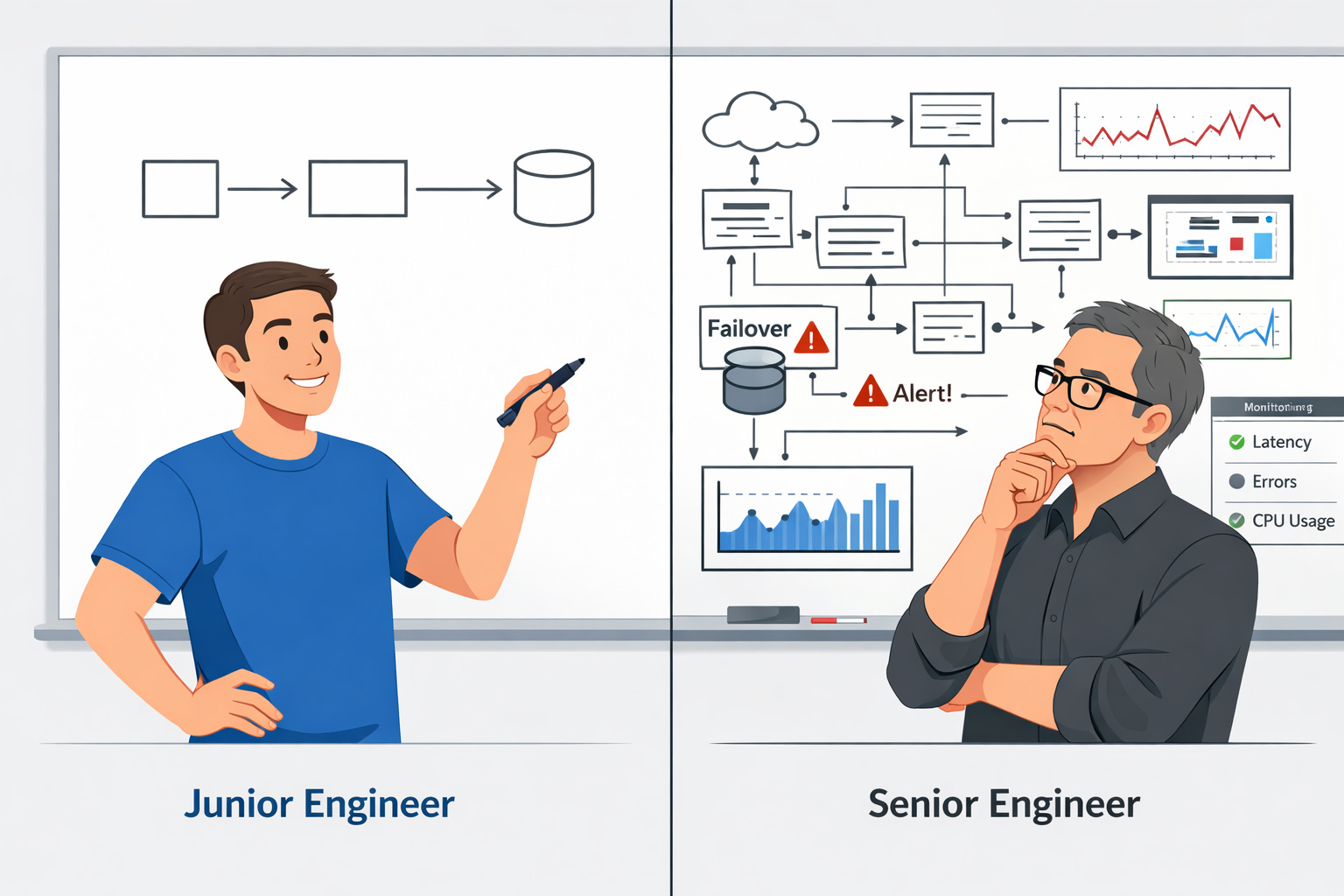
At FAANG+ companies and for senior roles, system design tests both the breadth and depth of your knowledge. Done right, you cannot game this interview by memorizing solutions like you might for coding problems on LeetCode. Even if you have seen the exact question before, a skilled interviewer will find the gaps in your understanding.
The real test: System design interviews reveal whether you have actually built and operated systems at scale, or whether you have just read about them. You cannot fake experience when someone starts asking about failure modes and operational concerns.
This is what makes system design the best filter for identifying engineers with real working experience. The patterns of thought, the instincts about what can go wrong, the awareness of operational costs - these things only come from having been there and done that.
What to Expect in the Room
System design rounds typically run either 45 minutes or 60 minutes. Here is something critical that many candidates miss: there is no way anyone can finish a perfect system design in that time. Interviewers know this. They do not expect a flawless solution.
What they expect is a demonstration of how you think through problems. They want to see your process, your trade-off analysis, and your ability to make reasonable decisions under constraints.
Every interviewer has specific areas they care about. Maybe they are deeply interested in database choices. Maybe they want to explore caching strategies. Maybe they are focused on consistency guarantees. Your job is to pick up on these signals and engage with them.
Here is a mistake that shows up constantly: candidates come in with a prepared script. They have memorized a solution for “Design Twitter” or “Design Uber” and they recite it regardless of what the interviewer asks. By the end, the candidate feels great because they covered everything they prepared. Then they get rejected because they never gave the interviewer a chance to deep dive into the areas they actually cared about.
There is another problem with ignoring signals. Once you start digging into an area that the interviewer does not care about, it is very hard to come out of it cleanly. You lose time, you lose momentum, and you end up rushing through the parts that actually matter.
System design is a discussion, not a monologue. You are designing together with the interviewer, and you are leading that discussion. But you have to engage with them and build the solution collaboratively. If you just keep talking and dump everything you know, you will fail even if your technical knowledge is solid.
Time Management: The Silent Killer
Time management separates good candidates from great ones. Without a structure, you will either spend 30 minutes on requirements gathering and run out of time for the actual design, or you will rush through everything and miss critical depth.
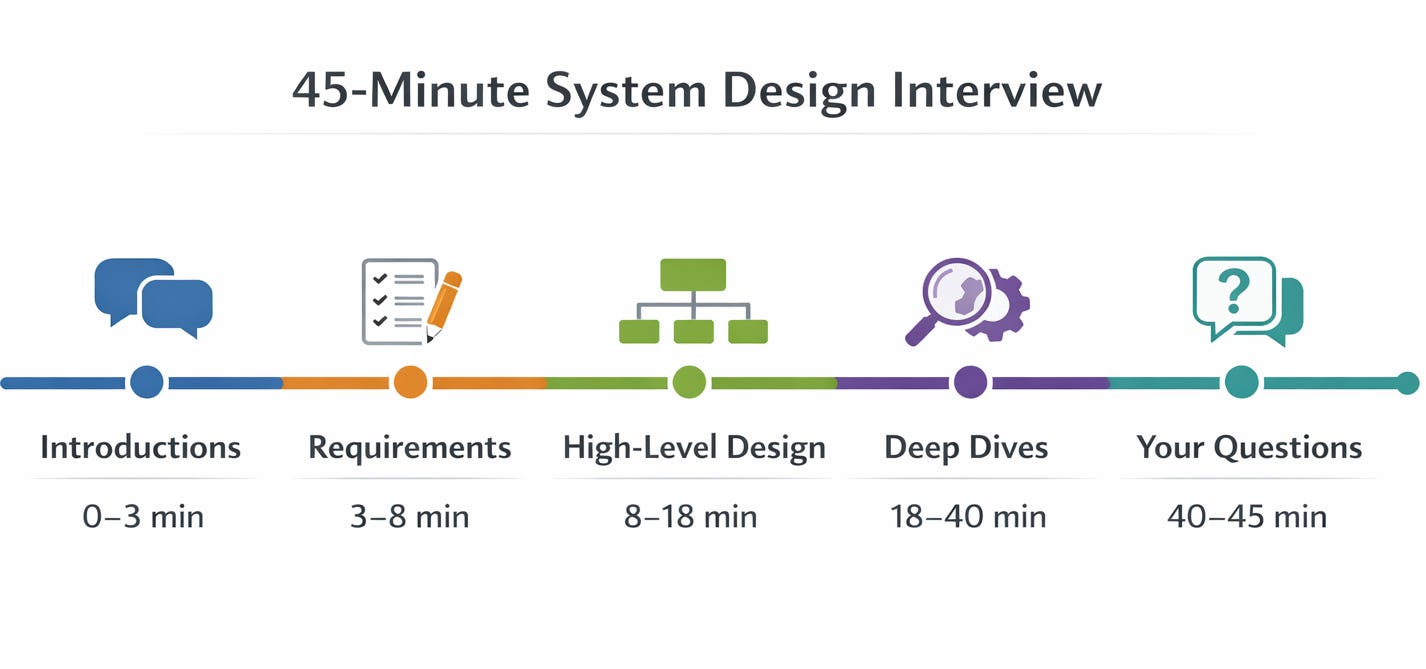
Keep in mind that a 45-minute interview is not really 45 minutes of design time. You lose 2-3 minutes at the start for introductions and 2-3 minutes at the end for your questions about the company and team. So you are really working with about 40 minutes.
Here is a rough breakdown that works for most 45-minute interviews:
Introductions: 2-3 minutes
Understanding and requirements: 5 minutes
High-level design (big picture): 10 minutes
Deep dives: 20-22 minutes
Your questions about the team/company: 2-3 minutes
For 60-minute interviews, you get more breathing room. Spend 8-10 minutes on requirements, 12-15 minutes on the big picture, and 30-35 minutes on deep dives. The extra 15 minutes mostly goes into deeper exploration.
The key insight here is that you need to know where you are at all times. If you are 20 minutes in and still discussing requirements, something has gone wrong. If you are 35 minutes in and have not started any deep dives, you are in trouble.
The Structure That Works
Having a structure is important, but do not treat it as the only way. You can adapt and improvise as long as you are confident about your approach. That said, here is the structure that works for most people.
Phase 1: Understanding the Question
Take 2-3 minutes, sometimes even 5 minutes, to just read and understand the question. Do not start talking immediately. Do not start drawing boxes. Just read.
This sounds obvious, but countless candidates miss critical parts of the question because they are too eager to start showing off their knowledge. The question often contains hints about what matters. A question that mentions “millions of users” is telling you that scale matters. A question that mentions “real-time” is telling you that latency matters. Read carefully.
Phase 2: Gathering Requirements
This is where many candidates go wrong. They either ask too many questions before showing any independent thinking, or they make too many assumptions without clarifying anything.
Here is the right approach: use a two-step process.
Step one: Write down your understanding of the functional requirements. List what you think the system needs to do based on the question. This shows the interviewer that you can analyze a problem and form your own understanding.
Step two: Ask clarifying questions about missing information. Now that you have demonstrated your thinking, ask about gaps and ambiguities.
Why this order matters: If you start asking questions before writing anything down, the interviewer has no way to judge your understanding of the problem. They do not want to spoon-feed you requirements. They want to see what you can figure out on your own first.
Do the same for non-functional requirements. State your understanding of what matters (latency, throughput, consistency, availability), then ask for clarification.
By the end of this phase, you and the interviewer should agree on both functional and non-functional requirements. This alignment is critical because everything else builds on it.
Reading the Signals
Here is something subtle but important. During requirements gathering, you will start to sense which parts of the problem the interviewer cares about.
Say you are designing a system like Pastebin. You ask about authentication requirements. If the interviewer says “any authentication is fine” or “not a primary concern for this problem,” that is a clear signal. They do not want you to spend time on authentication. They have something else in mind.
These signals are everywhere if you pay attention. When an interviewer leans in or asks follow-up questions, they are interested. When they give quick, dismissive answers, they want to move on. Learn to read these cues.
Phase 3: The Big Picture
The big picture is the skeleton of your design without getting into the details of anything. You are showing how requests flow, how data moves through the system, what components exist, but you are not making concrete technology choices yet.
Think of it as drawing a map before deciding which roads to take. You want the interviewer to see the overall shape of your solution before you start optimizing specific parts.
This phase should take 10-15 minutes. The key is to explicitly tell the interviewer what you are doing: “I am going to draw a high-level picture first to show the overall flow, and then we can dive deeper into specific components.”
This communication matters. The interviewer needs to understand your process. If you start drawing boxes without explaining your approach, they might think you are already in the details when you are just sketching the outline.
Phase 4: Deep Dives
This is where the real interview happens. By now, you either know which sections to explore deeply, or the interviewer will tell you explicitly.
But here is what separates good candidates from great ones: do not just wait for the interviewer to direct you. The most important thing that should come out of your system design interview is your proactive thinking.
The best area to show this is failure modes. Instead of waiting for the interviewer to ask “what happens if this service goes down,” you should identify failure scenarios yourself and present them.
This component is a single point of failure. If it goes down, here is what breaks. To mitigate this, we could do X or Y. I would recommend Y because...
This is what real senior+ engineers do. They do not wait for problems to be pointed out. They anticipate them.
The Infinite Resources Trap
This is the most common pitfall, especially from candidates who have read a lot but have not built much.
They will throw in every technology they have heard of. Kafka for messaging. Redis for caching. Elasticsearch for search. Cassandra for writes, PostgreSQL for reads. A separate analytics pipeline. Machine learning for recommendations. CDN for static content. Multiple regions for availability.
And they never stop to think: who is going to operate all of this? What happens when Kafka has a partition issue at 3 AM? How do you debug a request that touches seven different services? What is the cost of running all this infrastructure?
The reality check: An engineer who has spent sleepless nights on production incidents knows the importance of system reliability and manageability. An engineer who has only read about these systems will happily add complexity without understanding the operational cost.
Real experience shows in how you think about operations. Do you consider what happens when things fail? Do you think about the on-call engineer who will debug this at 2 AM? Do you understand that every additional component is another thing that can break?
This is why system design interviews are so effective at identifying real experience. You cannot fake this perspective. An engineer trying to portray themselves as experienced without having actually been there will fail. Either you have been burned by complexity and learned to respect simplicity, or you have not. There is no middle ground.
What Changes at Each Level
System design interviews are calibrated differently depending on the level you are interviewing for. Understanding these differences helps you focus on what matters.
Software Engineer (SWE)
At this level, interviewers want to see that you understand the basics. Can you break down a problem? Do you know what a load balancer does? Can you explain why you need a cache?
The expectations are:
Clear problem decomposition
Understanding of basic components (databases, caches, queues)
Ability to make simple trade-off decisions
Awareness that scale and reliability matter
You are not expected to design a globally distributed system. You are expected to show foundational knowledge and the ability to reason through problems.
Senior Software Engineer (SSE)
Now the bar goes up. You should be able to design a complete system end-to-end. Trade-off discussions become more important. You need to explain why you chose PostgreSQL over Cassandra, not just pick one randomly.
The expectations are:
End-to-end system design capability
Clear articulation of trade-offs
Understanding of scaling strategies
Awareness of operational concerns
Ability to estimate capacity and identify bottlenecks
At this level, interviewers start probing your depth. They want to see that you have actually worked with these systems, not just read about them.
Staff Engineer
Staff level is where quality of judgment becomes the primary evaluation criteria. This is what you are paid for at this level, not how much code you write or how fast you ship.
There will be scenarios where you have to choose between X and Y, and the right answer is not obvious. Maybe both options have significant trade-offs. Maybe the data is incomplete.
It is perfectly fine to say “I do not know which is better at this point, but I would collect more data on A, B, and C before deciding. Based on what we know now, I am leaning toward X because...”
This is what interviewers want to see. They want to know how you handle ambiguity and make decisions with incomplete information.
The expectations are:
Excellent judgment on complex trade-offs
Ability to handle ambiguity gracefully
Understanding of organizational and team impacts
Proactive identification of risks and failure modes
Clear communication of reasoning
Senior Staff and Principal
At this level, the scope expands beyond the system itself. You are expected to think about multi-year technical strategy, cross-team dependencies, and organizational implications.
Interviewers might ask questions like: “How would you migrate from the current system to this new design?” or “What team structure would you need to build and maintain this?” or “How does this fit with the company’s broader technical direction?”
The expectations are:
Strategic thinking about technical direction
Understanding of multi-team coordination
Ability to design for long-term evolution
Migration and adoption strategy
Influence and alignment skills
The system design itself is almost secondary. What matters is how you think about building technology organizations and making decisions that affect hundreds of engineers.
What a Good Interviewer Looks Like
Knowing what a good interviewer does helps you recognize a fair interview and adjust when you are not getting one.
They guide without giving answers. If you are stuck, a good interviewer will drop hints or ask clarifying questions to nudge you forward. They will not let you flounder in silence, but they will not hand you the solution either.
They adapt to your level. A good interviewer is not trying to prove how hard the question is. They are trying to find where your knowledge ends. If you are clearly handling something well, they will push deeper. If you are struggling, they might simplify or redirect.
They tell you what they want. Vague interviewers who give no feedback and just watch you struggle are not running a fair evaluation. Good interviewers will say things like “let us focus on the database layer” or “walk me through the failure scenarios.” They give you direction.
They take notes instead of judging in real-time. If an interviewer seems distracted or checked out, that is a red flag. Good interviewers are engaged, listening, and writing things down.
Common Mistakes to Avoid
The same mistakes show up over and over again. Here is what to avoid:
Starting to draw before understanding the problem. Take time to read and think. The eager candidate who starts drawing immediately often misses critical requirements.
Asking questions without showing your own thinking. Always demonstrate your understanding first, then ask for clarification. Do not expect the interviewer to define the problem for you.
Ignoring the interviewer’s signals. If they seem uninterested in a topic, move on. If they keep asking follow-up questions, go deeper. Read the room.
Treating it as a presentation instead of a conversation. System design is collaborative. Engage with your interviewer. Ask for their input. Respond to their questions.
Assuming infinite resources. Every technology choice has costs. Every additional component adds complexity. Show that you understand operational reality.
Not managing time. Know where you should be at each point in the interview. If you are running behind, adjust.
Avoiding saying “I don’t know.” Pretending to know something you do not know is worse than admitting uncertainty. Good engineers know their limits.
Forgetting about failure modes. Production systems fail. Show that you think about what happens when things go wrong.
Preparation That Actually Works
Everyone asks how to prepare for system design interviews. Here is what actually works, based on patterns from successful candidates.
Build things. There is no substitute for actual experience. If you have never operated a system at scale, you will have blind spots that preparation cannot fill. Side projects, open source contributions, or taking on infrastructure work at your current job all help.
Read postmortems. Companies publish detailed analyses of outages. These are gold mines for understanding how real systems fail and how experienced engineers think about reliability.
Study real architectures. Many companies have published blog posts about their systems. Read about how Netflix handles streaming, how Uber manages rides, how Slack handles messaging. Understand the decisions they made and why.
Practice with mock interviews. Find someone to practice with. The experience of explaining your thinking out loud, under time pressure, with someone asking questions, is very different from thinking through a problem alone.
Focus on fundamentals. You do not need to know every database and every message queue. You need to deeply understand when to use different types of storage, how to handle consistency and availability trade-offs, how caching works, and how to scale systems.
The Bigger Picture
System design interviews exist because building software at scale is hard. The problems you encounter at 10,000 users are different from 10 million users. The decisions you make early can haunt you for years. The cost of getting it wrong is measured in downtime, lost revenue, and frustrated users.
What interviewers are really trying to understand is: can this person make good decisions about complex systems? Can they reason about trade-offs? Do they understand what they do not know? Will they build something that works, or something that looks good on a whiteboard but falls apart in production?
The engineers who do well in these interviews are the ones who have learned from experience. They have seen things break. They have debugged production issues at 3 AM. They have dealt with the consequences of poor architectural decisions. That experience shows in how they think and what they worry about.
You cannot fake experience. But you can build it.
How? Start paying attention to how the systems you work with actually behave. Ask questions about why things were built the way they were. Volunteer for on-call rotations. Read internal incident reports. Over time, you will develop the instincts that make system design interviews feel like natural conversations instead of tests.
That is the goal. Not to memorize answers, but to develop genuine understanding. When you have that, the interview stops being a test and starts being a conversation about systems you actually know how to build.
Master System Design @ System Overflow